Quick Summary
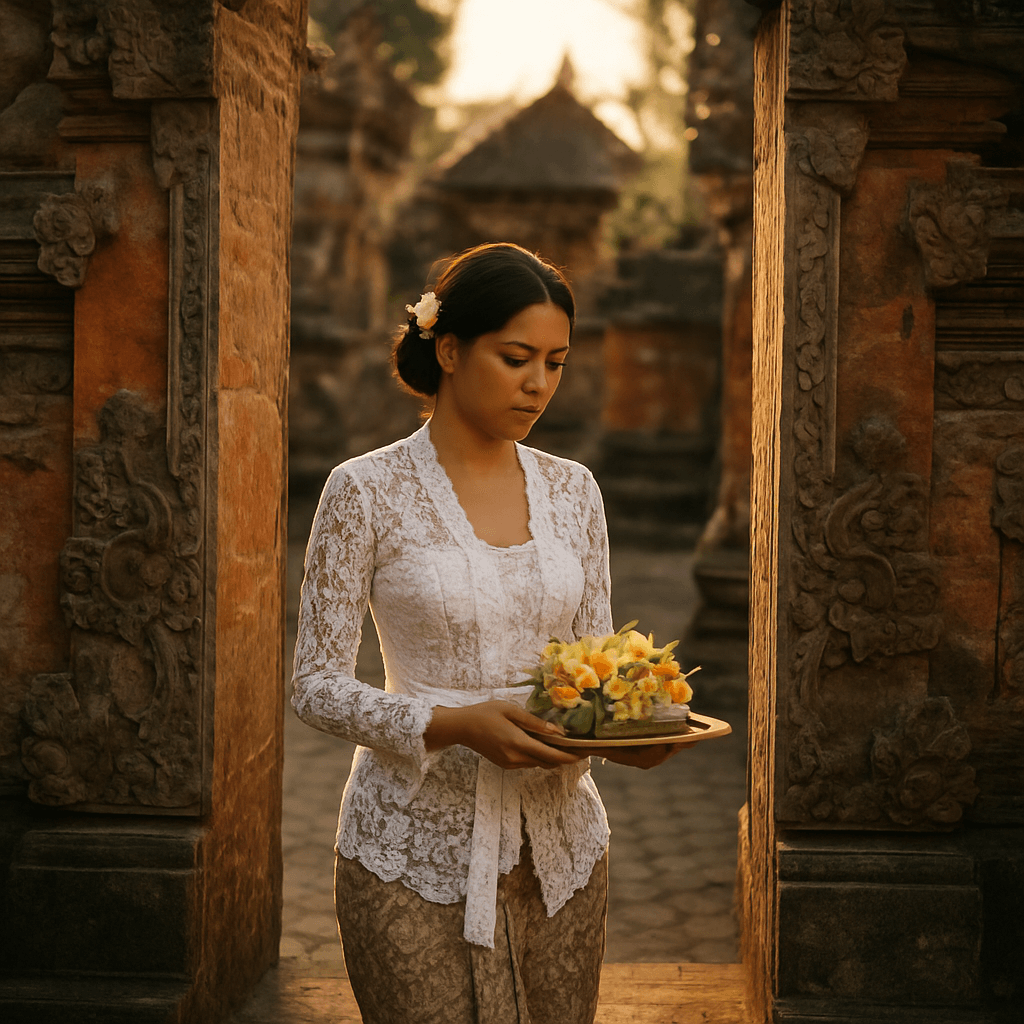
- Women's attire: kebaya + kamben + selendang, colour and detail vary by occasion
- Men's attire: udeng + shirt + kamben + saput
- Visiting a temple as a tourist: a kamben and selendang tied at the waist is usually sufficient
- Payas alit: simple everyday temple dress
- Payas agung: the most elaborate ceremonial dress, worn for weddings
What Is Traditional Balinese Dress?
Traditional Balinese dress, locally called "payas," is worn during Hindu Balinese religious activities — from daily temple prayers to odalan (temple anniversary celebrations) and life milestone ceremonies such as weddings and cremation rites (ngaben). It is not simply decorative clothing; it reflects respect for sacred spaces and generations of local craftsmanship.
The level of formality varies by occasion. Everyday temple visits call for a simpler version known as payas alit, while major ceremonies like weddings call for the far more elaborate payas agung.
What Do Balinese Women Wear for Traditional Dress?
Women's traditional Balinese dress has three main components:
- 1. Kebaya — a fitted blouse made from brocade, silk, or cotton, available in embroidered, painted, or plain styles.
- 2. Kamben — a long wraparound cloth worn as the bottom layer, typically in endek or songket weave for formal occasions.
- 3. Selendang — a sash tied around the waist over the kamben, marking modesty and completing the traditional silhouette.
Colour and level of detail are adjusted to the occasion — brighter colours and embroidered detail are more common for weddings, while neutral tones and plainer kebaya are typical for everyday temple visits.
What Do Balinese Men Wear for Traditional Dress?
Men's traditional Balinese dress consists of:
- 1. Udeng — a head cloth tied in a distinctive triangular shape, symbolising clarity of mind.
- 2. Shirt or upper garment — usually white or a neutral colour for temple visits.
- 3. Kamben — the same wraparound cloth as women's, tied using a different technique.
- 4. Saput — an additional cloth layered over the kamben, typically shorter and signalling a more formal level of dress.
What Should You Wear to a Balinese Temple?
For tourists and visitors, the essential rule is covering the waist downward with a kamben and tying a selendang around the waist. This applies to both men and women. A full traditional outfit is not required — a modest t-shirt or shirt is fine as long as the lower body is covered by a kamben.
Many major temples such as Tanah Lot or Uluwatu provide a kamben and sash to borrow at the entrance. However, bringing your own is more practical and hygienic, especially for frequent visits or more formal ceremonies.
What Is the Difference Between Payas Alit and Payas Agung?
Payas alit is the simple version of traditional dress worn for daily religious activities — routine prayers, small odalan, or temple visits. It consists of a kebaya or simple shirt, kamben, and selendang, without elaborate accessories.
Payas agung is the most elaborate and formal traditional dress, typically worn for Balinese weddings. It includes an ornate headpiece (a gelungan crown for women, an elaborate udeng for men), jewellery, and layered fabrics far more intricate than payas alit.
How Do Families Prepare Matching Traditional Dress?
Families preparing for a shared ceremony — such as odalan or a wedding — usually start by choosing a unified kamben colour and pattern, then coordinate kebaya styles for female family members and udeng for male members, keeping the overall look cohesive while suiting each person's age and role.
Agniantari offers family traditional dress set consultations with custom sizing patterns tailored to Balinese and Indonesian body shapes, made by local artisans in Jembrana — explore Agniantari's Balinese dress collection for kebaya, kamben, and udeng options, or consult directly for family sets.
Frequently Asked Questions
No, full traditional dress is not required. The minimum expectation is a kamben covering the waist downward and a selendang tied around the waist, for both men and women.
A kamben usually features distinctive Balinese motifs such as endek or songket weave and is wrapped using a specific technique, while a regular sarong is often plain or generically patterned and worn more casually.
An udeng is tied on the head with the triangular fold facing forward, symbolising clarity of mind — the folding technique varies by region and occasion.
There are regional variations in motifs and colours, though the basic structure — kebaya, kamben, and selendang for women; udeng, kamben, and saput for men — remains consistent across Bali.
Agniantari offers traditional Balinese dress — kebaya, kamben, udeng, and accessories — made by local artisans in Jembrana, with shipping available across Indonesia.
Conclusion
Traditional Balinese dress differs for women (kebaya, kamben, selendang) and men (udeng, kamben, saput), with formality ranging from everyday payas alit to elaborate payas agung for weddings. Understanding these components helps both Balinese communities and visitors show appropriate respect when entering sacred spaces.